Europe Telehealth & Telemedicine Market Size, Growth, Share & Trends Analysis

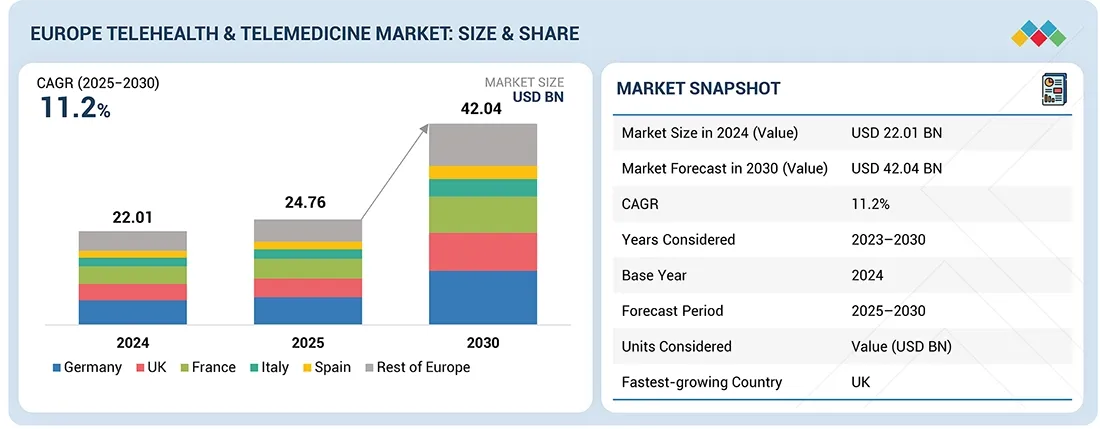
The Europe telehealth & telemedicine market, valued at US$22.01 billion in 2024, stood at US$24.76 billion in 2025 and is projected to advance at a resilient CAGR of 11.2% from 2025 to 2030, culminating in a forecasted valuation of US$42.04 billion by the end of the period.
Download PDF Brochure:- https://www.marketsandmarkets.com/pdfdownloadNew.asp?id=239047581
The growth of the Europe telehealth & telemedicine market is driven by the rising demand for remote healthcare services, increasing adoption of digital health platforms, and expanding broadband and mobile connectivity across the region. The growing emphasis on chronic disease management, combined with supportive government initiatives for virtual care, is further accelerating market expansion.
- The Germany telehealth & telemedicine market accounted for a 26.4% revenue share in 2024. This growth reflects increasing adoption of remote care solutions, stronger digital-health infrastructure, and rising demand for virtual consultations across the country.
- By component, the software segment is expected to register the highest CAGR of 11.8%. The segment’s strong momentum is driven by rising use of telehealth platforms, advanced virtual-care tools, and software that streamlines remote monitoring and clinical workflows across healthcare settings.
- By application, the specialty care segment is accounted for the largest share of 64.8% in 2024. Its dominance is supported by rising demand for remote access to specialists, improved virtual care pathways, and broader adoption of telemedicine across high-complexity therapeutic areas.
- Medtronic, Teladoc Health, Inc., Cisco Systems, Inc., were identified as some of the star players in the Europe telehealth & telemedicine market, given their strong market share and product footprint.
The telehealth & telemedicine market in Europe is growing as healthcare systems increasingly rely on digital platforms for remote consultations, virtual monitoring, and chronic disease management. Advancements in remote diagnostics, connected devices, and AI-assisted tools are improving care access and real-time decision-making.