Europe Pen Needles Market Size, Share & Growth

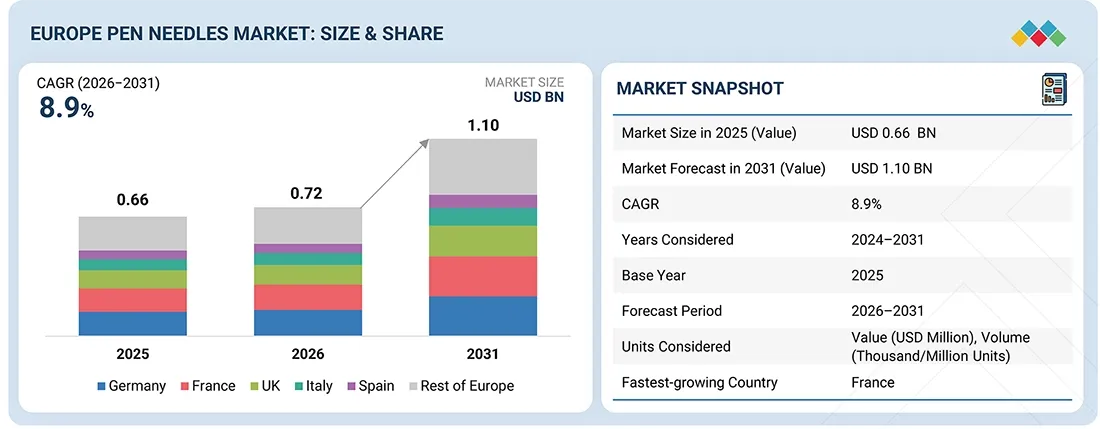
The global Europe pen needles market, valued at US$0.66 billion in 2025, stood at US$0.72 billion in 2026 and is projected to advance at a resilient CAGR of 8.9% from 2026 to 2031, culminating in a forecasted valuation of US$1.10 billion by the end of the period.
Download PDF Brochure:- https://www.marketsandmarkets.com/pdfdownloadNew.asp?id=159977651
The Europe pen needles market is propelled by soaring rate of diabetes prevalence, growing numbers of older adults, high levels of obesity, augmented uptake of insulin and GLP-1 pens leading to increased per-patient needle usage. Restraints listed would include challenges associated with pricing pressure, tender-driven commoditization, disparities in reimbursement across countries, and a decline in needle demand due to the longer-acting injectables.
- France is expected to register the highest CAGR of 9.7%.
- By type, the standard pen needles segment dominated the market, with a share of 84.2% in 2025
- By length, the 8mm segment dominated the market, with a share of 31.1% in 2024
- By application, insulin therapy will be the fastest-growing segment in the forecast period.
- By mode of purchase, the over-the-counter segment dominated the market, with a share of 30.8% in 2025
- By setting, the home care segment is expected to register the highest CAGR of 9.2%.
- Embecta Corp., Novo Norisk A/S and B.Braun SE were identified as Star players in the Europe pen needles market, as they have focused on innovation and have broad industry coverage and strong operational and financial strength.
- AdvaCare Pharma, MHC Medical Products, and Wellion distinguished themselves among startups and SMEs due to their strong product portfolio and business strategy
Factors such as increasing prevalence of diabetes, the aging population, rising obesity, and the adoption of insulin or GLP-1 pens, which allow for higher needs for needles per patient, further drive the European pen needles market. These, however, are counteracted by major limiting factors such as increased pricing pressure due to tender-based procurement, along with reimbursement inconsistencies across countries, and the reduced needle volume due to longer-acting injectable products. Major opportunities exist in safety-engineered and ultra-thin needle innovation, eco-friendly and connected disposable solutions, the growing e-pharmacy and home-care channels, and OEM partnerships to support premiumization, adherence improvement, and strengthened distribution across Europe's evolving outpatient care landscape.