Brazil Emerges as Strategic Hub in the $24.70 Billion Global Oligonucleotide Synthesis Market

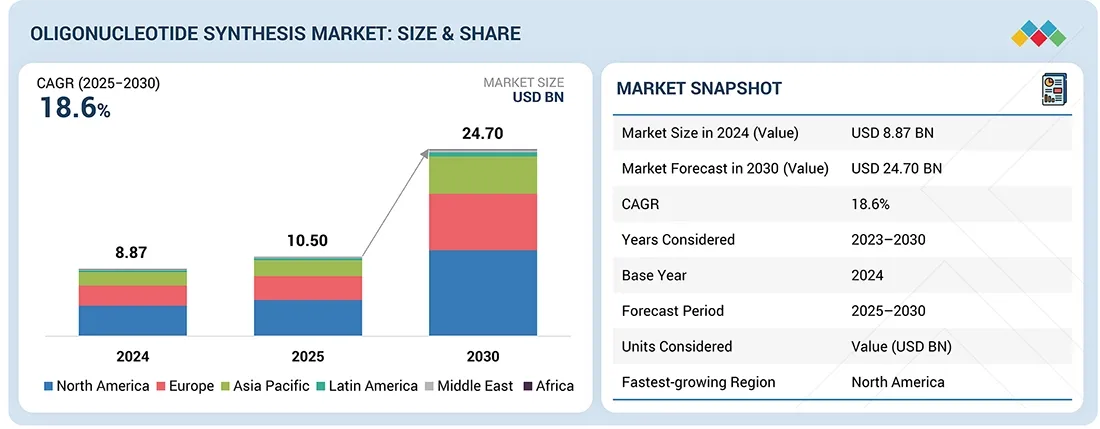
The global biotechnology sector is witnessing a transformative shift as the oligonucleotide synthesis market is projected to reach a valuation of USD 24.70 billion by 2030. Rising from USD 10.50 billion in 2025, the industry is expanding at a robust Compound Annual Growth Rate (CAGR) of 18.6%. This growth is underpinned by the rapid diversification of synthetic DNA and RNA applications in custom therapeutics, diagnostic probes, and the burgeoning field of synthetic biology.
Download PDF Brochure:https://www.marketsandmarkets.com/pdfdownloadNew.asp?id=200829350
Global Market Overview and Growth Catalysts
The primary momentum behind the market is the transition from traditional chemical-based therapies to advanced biologic solutions. High-demand segments such as antisense oligonucleotides (ASOs) and small interfering RNA (siRNA) are at the forefront of treating rare genetic disorders and neurological conditions.
The market's expansion is further fueled by:
- Precision Medicine: A global shift toward personalized treatment protocols requiring custom-synthesized oligos.
- Diagnostic Innovation: Increased utilization of molecular diagnostics and genomic testing, particularly following the global infrastructure upgrades for PCR and NGS technologies.
- Government Investment: Significant funding into life science research and synthetic biology across both developed and emerging economies.
Key Trends and Industry Disruptors
Technological advancements in solid-phase and enzymatic synthesis are enabling the production of longer, higher-purity sequences with faster turnaround times. However, the industry faces complex challenges, including the high cost of large-scale GMP manufacturing and environmental concerns regarding chemical waste. To mitigate these, players are increasingly investing in sustainable synthesis technologies and advanced delivery mechanisms like lipid nanoparticles to ensure oligonucleotides can cross biological barriers effectively.
Regional Insights: Brazil’s Strategic Role in a Global Context
While North America remains the dominant market shareholder—accounting for 45.4% of the industry in 2024 due to its established pharmaceutical infrastructure—the growth trajectory is shifting toward high-potential regions.
Brazil has emerged as a vital strategic hub within the Latin American landscape. As one of the fastest-growing emerging economies in the sector, Brazil’s increasing healthcare expenditure and developing biotech infrastructure make it a critical node for global players looking to expand their clinical trial footprints and distribution networks. Alongside China and India, Brazil provides lucrative opportunities for R&D investment, particularly as the demand for affordable molecular diagnostics and localized therapeutic manufacturing rises.
In Europe and the Asia Pacific, strategic collaborations and favorable government initiatives for genomic research continue to drive adoption, while the Middle East and Africa are seeing steady improvements in healthcare infrastructure that support the long-term uptake of oligo-based drugs.
Competitive Landscape
Theoligonucleotide synthesis marketis characterized by a mix of established life science giants and specialized biotech firms. Industry leaders such asDanaher Corporation (US),Thermo Fisher Scientific Inc. (US), andMerck KGaA (Germany)continue to expand their portfolios through aggressive acquisition strategies and the launch of GMP-grade supply chains.
Meanwhile, emerging leaders likeMaravai LifeSciences (US)are carving out significant niches in the modified-nucleotide space, essential for mRNA and siRNA programs. In the therapeutic domain, companies likeAstraZeneca (UK)andAlnylam Pharmaceuticals, Inc. (US)are leading the charge in bringing new ASO and siRNA drugs to market.
Future Outlook
As the industry moves toward 2030, the integration of Generative AI in drug design and sequence optimization is expected to further accelerate development timelines. With a robust clinical pipeline and an increasing number of FDA and EMA approvals for rare disease treatments, the oligonucleotide synthesis market is set to remain a cornerstone of 21st-century medicine, offering hope for previously untreatable conditions on a global scale.
Download PDF Brochure:https://www.marketsandmarkets.com/pdfdownloadNew.asp?id=200829350